
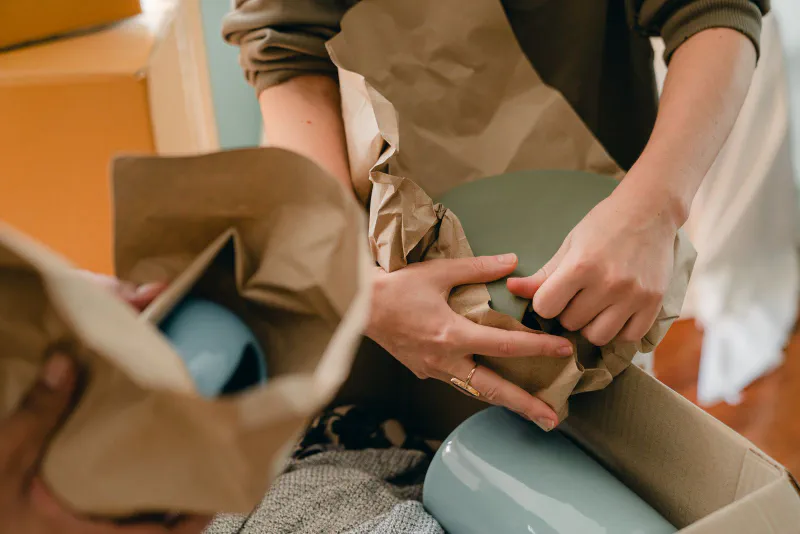
To pack a fragile item, wrap it so nothing hard touches it, put it in a corrugated box with cushioning on every side, fill the box until the item cannot move, and close every seam with 2 inch packing tape. The decision that costs money is box size: for a Priority Mail Express, Priority Mail or USPS Ground Advantage parcel over 1 cubic foot, USPS charges on the dimensional weight whenever that is greater than the actual weight.
This post packs one object, a ceramic vase, and stops at each decision. Item-by-item service picks and price ranges live on the main site, for example the cheapest way to ship pottery and ceramics and mugs . This post is about the pack-out itself.
The vase
A glazed ceramic vase, 10 inches tall and 6 inches across at its widest. It weighs 2 lb 4 oz on a kitchen scale.
Decision 1: wrap, and fill the hollow
USPS’s packaging standard is one sentence long: “Mailers must package mailpieces to withstand normal transit and handling without breakage or deterioration of content” (DMM 601.3.1 ). The same section says to cushion fragile items “to withstand handling in processing, transportation, and delivery.”
For the vase that means two things before a box is involved:
- Stuff the inside with crumpled paper, so the wall is supported from both sides.
- Wrap the outside completely, including the base and the rim, and tape the wrap to itself so it cannot slide off.
DMM 601 adds a rule sellers break when they combine an order: “Do not package high-density heavy items with fragile items unless extreme care is taken to separate them.” If the buyer also ordered a cast iron trivet, the trivet gets its own box.
Decision 2: which box
USPS allows corrugated fiberboard boxes for loads up to 70 pounds and thin paperboard boxes, the kind a gift or shoe box is made of, only for loads up to 10 pounds (DMM 601.4.2). The box “must be adequate to contain the items and provide enough space for cushioning material.” A wrapped vase goes in corrugated.
Reusing a box is fine if it is still stiff. USPS warns that “boxes can weaken during shipping” and tells mailers to make sure “all old logos, barcodes, shipping labels, and addresses are covered or blacked out” (USPS, preparing packages ).
Now the size. The vase needs cushioning all around, and there are two common ways to give it that.
Option A: one box, snug
A 10 x 10 x 14 inch box leaves 2 inches of cushioning on every side of the vase.
- Volume: 10 x 10 x 14 = 1,400 cubic inches
- Under the USPS threshold of 1,728 cubic inches, so the label is priced on actual weight
- Packed weight with box and fill: about 3 lb on the scale, so a 3 lb label
Option B: box inside a box
Double boxing puts the wrapped vase in a snug inner box, then floats that box inside a larger one. With an 8 x 8 x 12 inch inner box and 2 inches of fill around it, the outer box is 12 x 12 x 16 inches.
- Volume: 12 x 12 x 16 = 2,304 cubic inches
- Over 1,728 cubic inches, so USPS divides by 139: 2,304 / 139 = 16.58
- Rounded up to the next whole pound: billed as a 17 lb package
The rule is in DMM 123.1.3 for Priority Mail and DMM 133.1.4 for USPS Ground Advantage, with the same wording for Priority Mail Express in DMM 113.1.3 : for a parcel exceeding 1 cubic foot, round each measurement up to the next whole inch, divide the volume by 139 and round up, and pay on whichever is greater, the scale weight or that result.
| Option A: single 10 x 10 x 14 box | Option B: double box, 12 x 12 x 16 outer | |
|---|---|---|
| Volume | 1,400 cubic inches | 2,304 cubic inches |
| Over 1 cubic foot? | No | Yes |
| Weight USPS bills | About 3 lb (actual) | 17 lb (dimensional) |
Same vase, two honest ways to protect it, and one of them is billed at nearly six times the weight. To see what that gap costs on your lane, compare the 3 lb and 15 lb or 20 lb pages, or put both boxes into the dimensional weight calculator .
How to choose between them
Double boxing is the stronger pack. It is worth the billed weight when the item is irreplaceable or the sale price dwarfs the postage. For an everyday piece, a single box with cushioning on all six sides and no movement can meet the USPS standard at a fraction of the billed weight, provided the box and cushioning are enough to carry the item through normal transit and handling without breakage (DMM 601.3.1). No movement is one part of that standard, not the whole of it.
A middle path exists for smaller pieces: an outer box of exactly 12 x 12 x 12 inches is 1,728 cubic inches, which does not exceed the threshold. Anything that double-boxes inside a 12 inch cube ships on actual weight.
Decision 3: fill until nothing moves
DMM 601 is specific about loose fill such as packing peanuts or crumpled paper: it “must overfill the container before closure to hold the item” in place. A box that is merely full can still let the item shift.
The test costs nothing. Close the flaps without taping and shake the box. If you feel or hear the vase shift, open it and add fill. USPS also asks for packaging that “doesn’t bulge”, so the fill should resist the flaps without forcing them into a dome.
Decision 4: tape and seams
- Use packing tape at least 2 inches wide, and “enough 2-inch-wide packing tape to close and secure all seams” (USPS).
- DMM 601.3.14 excludes cellophane tape and masking tape as closures.
- Do not tie the box with string, cord or twine. USPS says it “gets caught in USPS sorting equipment.”
Tape the center seam, then both edge seams, top and bottom.
Decision 5: markings and the label
A “Fragile” marking is allowed only on packages that really contain delicate items, and it must be readable from 30 inches away (DMM 601.5). The marking changes nothing about the standard the box has to meet, so mark the box if you like, and pack as if nobody will read it.
Put the label flat on the largest side. USPS’s instruction is to “put all labels on the same side, and don’t fold them, bend them over edges, or overlap them.” USPS also suggests putting a slip of paper with the recipient’s name and address inside the box.
Decision 6: photograph the pack-out
Priority Mail and USPS Ground Advantage each include up to $100 of insurance (USPS insurance and extra services ). If the vase arrives broken, the USPS claims page sets out what a claim needs:
- A claim for damage can be filed immediately and no later than 60 days after the mailing date.
- You need proof of value, such as a sales receipt or paid invoice.
- You need proof of damage. USPS says photos that clearly show the extent of damage will help, and tells recipients: “Do not throw out damaged items, even after you photograph them.” You may be asked to bring the package in for inspection.
Two photos taken at your packing table, one of the wrapped item in the open box and one of the sealed box, cost ten seconds. Ask a buyer who reports damage to keep the box and everything in it. For items worth more than the included amount, the glossary entry on shipping insurance covers the options.
When the fragile item is a liquid
Glass bottles add a second failure: leaking onto other mail. DMM 601.3.4 has four rules for liquids. The container must close securely: a screw-on cap with at least one and a half turns, soldering, clips or similar means. The outer box of any package containing liquid must be marked to show that it holds liquid. A package holding more than 4 ounces of liquid needs orientation arrows on two opposite sides, with the closure of the container upright (Publication 52, section 223 ). And a breakable container of more than 4 fluid ounces, which includes glass and plastic, must be triple-packaged: absorbent cushioning able to soak up all of the liquid, a sealed leakproof secondary container, and a strong sealed outer box. The section allows one alternative to triple packaging, a container certified under International Safe Transit Association (ISTA) Test Procedure 3A, with written test results available on request. Some liquids, perfume among them, are also hazardous materials, and their packaging rules apply at any bottle size. See what declaring hazmat on a label actually does .
The pack-out on one card
| Step | Check |
|---|---|
| Wrap | Fully covered, hollow filled, no heavy item sharing the box |
| Box | Corrugated, stiff, old markings covered |
| Size | At or under 1,728 cubic inches if the item allows |
| Fill | Overfilled, nothing moves when shaken |
| Tape | 2 inch packing tape on every seam, no string |
| Label | Flat on one side, not over an edge |
| Record | Two photos before the box leaves |
Sources
Checked October 12, 2026 against DMM 601, Mailability (sections 3.0 to 5.0), DMM 113 , 123 and 133 (dimensional weight), Publication 52, section 223 , and the USPS pages on preparing packages , insurance and extra services and filing a claim . The vase, its weight and the box sizes are a worked example; weigh and measure your own packed box before buying a label.