
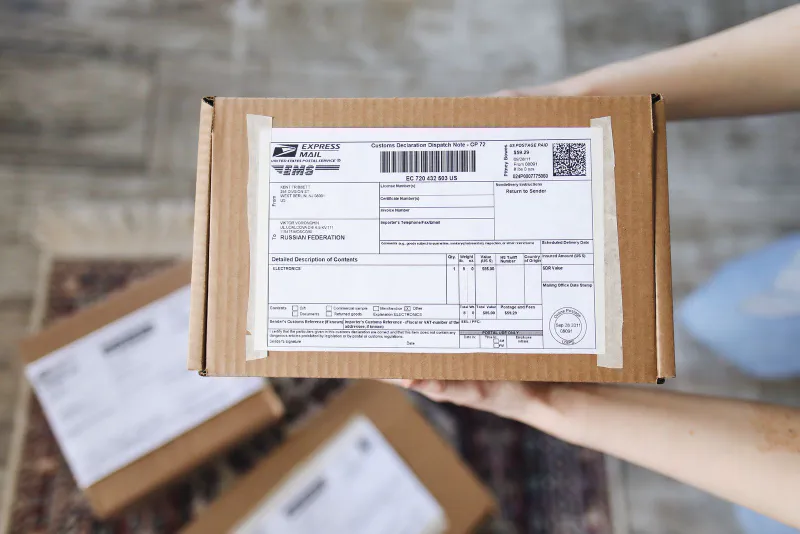
A commercial invoice is the document customs officials in the buyer’s country use to assess import duties and taxes. A USPS international label carries that declaration on the customs form generated with it, and a separate invoice is added only where required. A UPS international shipment of goods needs the invoice itself, on paper or sent digitally.
The definition comes from the U.S. International Trade Administration, which calls the commercial invoice “a required document for the export and import clearance process” (trade.gov). The rest of this post is about filling one in so the package is not held.
USPS: the customs form carries the declaration
USPS requires a customs form on international shipments, with one narrow exception: First-Class Mail International items under 15.994 oz that contain only documents or correspondence (USPS customs forms). Everything a seller ships as merchandise needs the form.
Three rules from the USPS International Mail Manual, section 123 matter to a small seller:
- The form must be generated electronically. The manual states, “All customs forms must be electronically generated.” Preprinted forms completed by hand are obsolete. Buying the label online or in a shipping app produces the form and transmits the data for you.
- Each item needs its own line. USPS requires “a detailed description of contents, including the quantity, net weight, and value for each item in the package.”
- A commercial invoice “must be completed where required.” USPS does not ask for one on every package. Whether one is required depends on the destination country and the contents, so check the country’s listing before shipping commercial goods.
On tariff codes, the two USPS pages differ slightly. The International Mail Manual lists a 6-digit Harmonized System (HS) code for each item as a required element unless the country listing says otherwise. The consumer customs page says USPS assigns an HS code during processing if you do not supply one. Supplying it yourself removes the guesswork. The harmonized code glossary entry explains how the codes are built.
UPS: you supply the commercial invoice
UPS treats the commercial invoice as the basis of the customs declaration. Its commercial invoice guide says plainly that without one “you are unable to ship overseas,” and that on paper it requires three signed copies, one original and two copies, included with the shipment. UPS also tells shippers to keep a signed copy for their own records.
The digital route replaces the paper copies. The UPS 2026 Rate and Service Guide (updated September 7, 2026) lists a Paper Commercial Invoice Services Surcharge of $40.00 per shipment when the invoice is not submitted digitally through UPS Paperless Invoice before UPS processes it. Check the current UPS guide for the figure in force when you ship.
What goes in each commercial invoice field
The UPS guide walks through the form section by section. The same information is what a USPS customs form asks for in fewer boxes.
| Field | What to enter |
|---|---|
| From | Your contact name, full address with postal code and country, phone number, and tax ID if you have one |
| Ship to | The recipient’s contact name, full address, and phone number |
| Sold to | The buyer, when the buyer is not the recipient |
| Tracking number | The number on the shipping label; for several packages, the first one |
| Date | The date of the sale in your records, not the pickup date |
| Terms of sale | The Incoterm: who pays shipping, insurance, duty, and tax |
| Reason for export | Sale, gift, repair, and so on |
| Description of goods | What it is, what it is made of, and what it is used for |
| Units and unit value | How many of each item, and the value of one |
| Country of origin | Where the item was made, not where it ships from |
| Harmonized tariff code | The classification code for each item, when you have it |
| Totals | Value of all items, freight, insurance, number of packages, total weight, currency |
| Signature and date | Yours, on the declaration |
The Incoterms and DDP vs DDU glossary entries cover the terms-of-sale line, which decides whether your buyer gets a bill at the door.
From sale to customs clearance
-
List every item
One line per item: what it is, what it is made of, quantity, and value.
-
Add origin and code
Country where each item was made, and its harmonized tariff code.
-
Create the label
USPS: the customs form is generated with the label. UPS: send the invoice digitally or print three signed copies.
-
Attach the paperwork
Put printed documents with the shipment where the carrier can reach them.
-
Customs assesses
The destination country's customs office uses the declaration to charge duty and tax.
The commercial invoice mistakes that hold a package
Vague descriptions. “Gift,” “samples,” or “parts” does not tell a customs officer what to classify. Both carriers ask for the same three things: what the item is, what it is made of, and what it is for. “Women’s knitted cotton sweater” clears; “clothing” invites questions.
A value that is too low. UPS warns that if customs officials believe the valuation is not correct, “this can be a reason for them to hold a package for further investigation,” and that even a free sample should be valued at least at the cost of its materials. USPS is blunter in the International Mail Manual: a false, misleading, or incomplete declaration “can result in the seizure or return of the item.”
Country of origin confused with country of shipment. UPS gives the example directly: goods made in Italy and shipped from the United States have Italy as the country of origin.
Forgetting the export filing line on a large order. U.S. export rules exempt a shipment from an Electronic Export Information filing when the goods under a single classification code, sent from one exporter to one recipient, are valued at $2,500 or less (15 CFR 30.37(a)). The exemption is measured per classification code, and it does not cover every kind of goods. An order above that line generally has a filing step before the label, unless another exemption applies. The one most sellers meet is Canada: a shipment from the United States whose final destination is Canada is exempt whatever its value (15 CFR 30.36). Neither exemption covers goods that need an export license or the other shipments listed in 15 CFR 30.2(a)(1)(iv). Those must be filed regardless of value. USPS notes that complying with the Census Bureau requirement is the sender’s responsibility.
Sources
Checked October 12, 2026 against the International Trade Administration’s commercial invoice page, USPS customs forms, the USPS International Mail Manual, section 123, the UPS commercial invoice guide, the UPS 2026 Rate and Service Guide, and 15 CFR 30.2, 30.36 and 30.37. Destination countries set their own import rules, so confirm the requirements for the country you are shipping to.
Related Topics
- Customs forms and duties explains who pays what at the border
- The customs form glossary entry defines the USPS forms
- International shipping guides by country cover Canada, the United Kingdom, Australia, Mexico, Germany, and Japan
- Held in customs explains that tracking status and what to do about it