
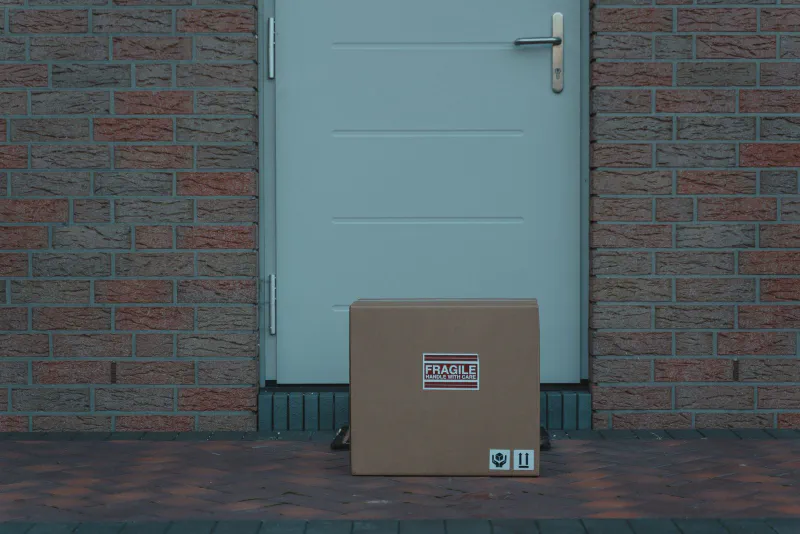
E-commerce made the parcel the carriers’ main product, and carriers rebuilt their pricing around it. A small seller now ships under five rules that follow from that shift: boxes are priced by size, online postage is priced below the counter, prices rise for the holidays, ground services were merged into one, and undeclared hazardous contents carry a fee.
Each of the five is a current USPS rule with a source, and each has a habit that keeps it from costing you.
The scale of the shift
The U.S. Census Bureau’s quarterly retail e-commerce report put e-commerce at 17.1 percent of total U.S. retail sales in the second quarter of 2026, seasonally adjusted, or $340.2 billion for the quarter, up 12.2 percent from a year earlier (release of August 18, 2026).
USPS named the same trend when it launched USPS Ground Advantage in 2023, saying it was ready to “compete for an increased share of the growing package business.” What follows is how that shift shows up on a label.
1. Carriers now charge for the space a box takes
A light, bulky box takes up space that a weight-based price does not pay for. Dimensional weight is the pricing rule that charges for the space.
Under DMM 123.1.3, a USPS Priority Mail parcel exceeding 1 cubic foot (1,728 cubic inches) is priced this way: round each measurement up to the next whole inch, multiply length by width by height, divide by 139, and round up to the next whole pound. You pay for that figure or the scale weight, whichever is greater. If dimensional weight comes out above 70 pounds, the 70 pound price applies.
What to do: measure every box, and treat 1,728 cubic inches as a line. A 12 x 12 x 12 inch box sits exactly on it and ships on actual weight. A 13 x 13 x 13 inch box does not. USPS Changed the Math on Your Boxes has the full threshold list, and the main site has a dimensional weight calculator.
2. Postage bought online is priced below the counter
USPS publishes two prices for the same package: a Post Office (retail) price and a lower Commercial price. The gap is visible on USPS’s own product page. A Priority Mail Express Flat Rate Envelope is listed at $38.25 at a Post Office and $33.46 at Commercial Pricing (USPS Priority Mail Express, as listed October 12, 2026).
What to do: check the online price before you pay at a counter. Label software such as I’d Ship That, which prints discounted USPS and UPS labels, shows the price for each service before you pay. Published prices by service are on the main site’s shipping rates pages.
3. Prices rise for the holidays
The weeks when online sellers ship the most are the weeks when postage costs the most. For the 2026 season USPS announced temporary prices on Priority Mail Express, Priority Mail, USPS Ground Advantage and Parcel Select, running from October 4, 2026 until January 17, 2027, for both retail and commercial customers. USPS’s stated reason: “to help cover extra handling costs to ensure a successful peak season.”
The increase is not flat. In the announcement, retail Priority Mail and USPS Ground Advantage rise by $0.50 for packages of 0 to 3 lb going to Zones 1 to 4, and by as much as $3.90 for the heaviest packages in those zones.
What to do: if you charge buyers a fixed shipping price, check it against October prices, not July prices. The main site tracks 2026 rate changes and the glossary explains peak surcharges.
4. USPS merged its ground services into one
Until mid-2023 USPS sold three separate ground products: USPS First-Class Package Service, USPS Retail Ground and USPS Parcel Select Ground. On July 10, 2023 USPS introduced USPS Ground Advantage and retired all three. USPS described the new service as delivering “in two-to-five business days across the continental United States”, with $100 of insurance included.
Old listings, shipping profiles and blog posts still name the retired services. If your store’s shipping settings mention First-Class Package, they are describing a product that no longer exists.
What to do: update any shipping profile that names a retired service, and read the current terms on the main site’s USPS Ground Advantage page or the Ground Advantage vs. Priority Mail comparison.
5. What is inside the box is now your job to declare
Perfume, batteries and used electronics are ordinary things to sell online, and all three are regulated in the mail. USPS puts the duty to say so on the mailer. Publication 52, section 323 says mailers “must identify whether a shipment contains hazardous materials when generating the label”, and the USPS shipping restrictions page lists a $50.00 HAZMAT noncompliance fee for commercial shipments that are improperly declared.
What to do: answer the hazmat question on every label, and learn which of your products count. Start with Can You Ship That?, then what declaring hazmat on a label actually does.
The five rules on one card
| Change | The USPS rule | The seller habit |
|---|---|---|
| Size-based pricing | Parcels over 1,728 cubic inches are billed by volume divided by 139 | Measure every box; stay at or under a 12 inch cube where you can |
| Online vs. counter pricing | Commercial prices are lower than Post Office prices | Check the online price before paying at a counter |
| Holiday pricing | Temporary increases October 4, 2026 to January 17, 2027 | Re-check fixed shipping charges each October |
| One ground service | USPS Ground Advantage replaced three services on July 10, 2023 | Remove retired service names from listings |
| Hazmat declaration | The mailer must declare when generating the label | Answer the question on every label |
Sources
Checked October 12, 2026 against the U.S. Census Bureau quarterly retail e-commerce sales page (second quarter 2026 release dated August 18, 2026; the Bureau revises these estimates in later releases); DMM 123; the USPS Priority Mail Express page; the USPS news releases of July 10, 2023 and August 25, 2026; Notice 123, effective October 4, 2026; Publication 52; and the USPS shipping restrictions page.