
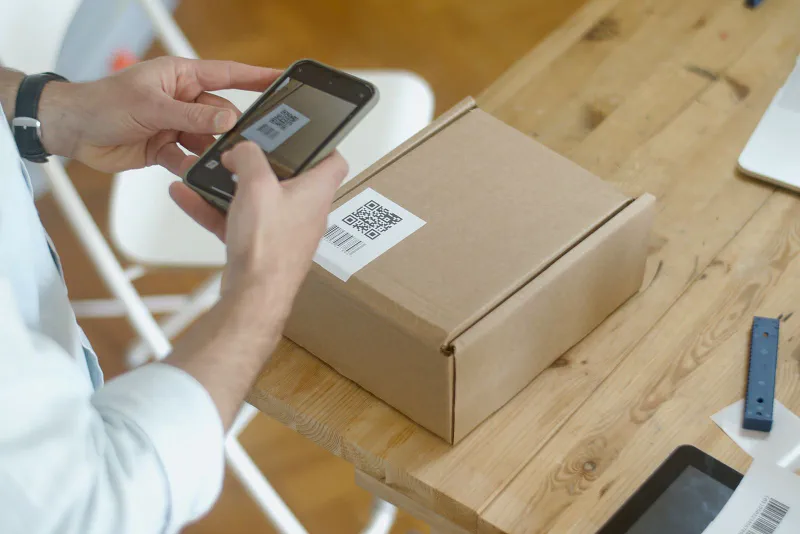
A tracking record is useful to a seller because it is evidence. It shows that a label existed, when the carrier first had the package, and the date and time a delivery or delivery attempt was recorded. It does not show who took the package in or what was inside it. Those gaps are what extra services and your own records cover.
This post looks at tracking as proof: which scan settles which argument, and what to add when tracking alone is not enough. For the meaning of an individual status, see the tracking status pages . For when a quiet tracking page becomes a claim, see package tracking .
What each stage of a tracking record proves
| Stage on the tracking page | What it proves | What it does not prove |
|---|---|---|
| Label created | A label was bought and a tracking number exists | That the carrier has the package |
| Acceptance or first carrier scan | The carrier recorded acceptance, with a date and time | Anything about delivery. A SCAN form event alone does not show that this parcel was in the batch |
| Delivered or delivery attempted | The date and time the carrier recorded delivery or an attempt | Who received it, or the condition of the contents |
Label created is not shipped
A tracking number is created with the label, before the package goes anywhere. USPS records the two moments as separate events: the event code tables in USPS Publication 199 (Appendix G, version 35) list “Shipping Label Created” and “Accepted at USPS Facility” as different entries.
The difference matters outside the carrier, too. The Federal Trade Commission’s shipping rule defines shipment as “the act by which the merchandise is physically placed in the possession of the carrier” (FTC business guide ). TikTok Shop treats an order as dispatched when a carrier scans it, not when tracking is uploaded (TikTok Shop Fulfillment Policy , dated September 28, 2026). A printed label sitting on your desk satisfies neither.
The acceptance scan is your proof of on-time shipping
A scan of the package itself by the carrier is the record that you handed it over, and when. If a buyer or a marketplace says you shipped late, the acceptance scan is what answers it. An acceptance event that comes from a SCAN form covers the batch, with the limit described below.
Two ways to make sure that scan happens on the day you ship:
- Hand packages over in person when the deadline is tight, and ask for them to be scanned before you leave. A package left for collection is scanned whenever it is next handled.
- Use a SCAN form for a batch. USPS PS Form 5630, the Shipment Confirmation Acceptance Notice, is a single sheet with one barcode that is linked to a group of prepaid packages (Publication 199, section 3.1.2.2). USPS says that when its employee scans that barcode, every package in the shipment receives an “Acceptance” event (Postal Bulletin 22239 ). Know what that event is. It is a scan of the form, not of each parcel, and the USPS procedure for its employees says there is “no requirement that the volume in each shipment be verified” (SCAN field information kit ). It records when the batch was accepted. By itself it does not show that a particular parcel was in the batch, so check every listed package is there and keep the scanned form with the day’s records. A different status, “Shipment Received, Package Acceptance Pending”, is not an acceptance scan at all: USPS says it means a facility has received a container of packages, and that each package gets its own acceptance scan once the container is opened (USPS tracking FAQ ). When to use one is covered in Do I need a USPS SCAN form?
Delivered proves a time, not a person
The USPS Domestic Mail Manual describes USPS Tracking as giving the mailer “information about the date and time an article was delivered or the date and time of the delivery attempt” (DMM 503 , section 7.1.1). It is a record that the carrier marked the delivery, and when. It carries no signature and no name.
The same section adds a point most sellers never see: USPS Tracking does not include insurance, and some laws that govern mailing legal documents may require Certified Mail or Registered Mail instead of USPS Tracking.
What to add when tracking is not enough
Each gap in a plain tracking record has a matching USPS extra service. All of these are defined in DMM 503.
| What you need to show | Service that covers it | What you get |
|---|---|---|
| Someone signed for the package | Signature Confirmation | A delivery record including the signature, kept by USPS and available electronically or by email on request |
| The addressee or their authorized agent received it | Signature Confirmation Restricted Delivery | Delivery limited to the addressee or their authorized agent |
| You mailed an item that has no tracking | Certificate of Mailing | Evidence the piece was presented to USPS. It is bought at a Post Office at the time of mailing, it does not record delivery, and USPS keeps no copy |
| The value of what was lost | Insurance | Priority Mail Express, Priority Mail and USPS Ground Advantage each include $100 of coverage. More can be purchased |
Current fees for these services are in the USPS price list, Notice 123 . The Signature Confirmation and shipping insurance pages explain when each is worth paying for.
Tracking is one part of a claim, not the whole claim
A tracking number is required to file a USPS insurance claim, but it does not establish what the package was worth. The USPS claims page asks for three kinds of evidence:
- Proof of insurance: the original mailing receipt, the outer packaging with the insured label, or a printed online label record.
- Proof of value: a sales receipt, paid invoice or similar document showing the item’s cost when mailed.
- Proof of damage, for damaged items: photos, and the original packaging and contents kept until the claim is settled.
The dates are fixed, and they count from the mailing date:
| USPS step | Earliest | Latest |
|---|---|---|
| Missing Mail search request | 7 days after mailing | Not stated |
| Claim for a lost Priority Mail or USPS Ground Advantage package | 15 days after mailing | 60 days after mailing |
| Claim for a lost Priority Mail Express package | 7 days after mailing | 60 days after mailing |
| Claim for damage or missing contents | Immediately | 60 days after mailing |
The search timing is from the USPS Missing Mail page . The claim windows are from the USPS claims page.
Keep your own copy of the record
Do not rely on the carrier’s website to hold your evidence. USPS sells a paid service, USPS Tracking Plus, that keeps a tracking history available for 6 months up to 10 years (Notice 123, effective October 4, 2026). The fact that long-term access is a paid option tells you the standard history is temporary.
A routine that costs nothing:
- Save the label record or receipt for every order. It is your proof of insurance.
- Keep the order record showing what the buyer paid. It is your proof of value.
- For orders you would not want to lose, save a screenshot or PDF of the tracking page once it shows the acceptance scan, and again once it shows delivery.
- Store all of it against the order number, not in loose email.
I’d Ship That keeps the label record and tracking number for each USPS and UPS label you buy, which covers the first item on that list.
Related reading
- How the number itself is built: Why do USPS tracking codes start with a 9?
- A delivered scan the buyer disputes: Delivered but not received
- A label that shows no movement: Shipping Label Created
- Coverage and when to buy more: Why insurance matters
Sources
USPS Domestic Mail Manual 503 (sections 1.4, 5.1, 7.1 and 8.1); USPS Publication 199, version 35 (July 2, 2026); USPS Postal Bulletin 22239 and the 2006 SCAN field information kit (Postal Bulletin 22192), which are the USPS descriptions of the SCAN form scan; the USPS tracking status FAQ; USPS Notice 123, effective October 4, 2026; USPS claims and Missing Mail help pages; FTC business guide to the Mail, Internet, or Telephone Order Merchandise Rule; TikTok Shop Fulfillment Policy dated September 28, 2026. All checked October 12, 2026.